
“I’ve got a bullet with your name on it, and we’re gonna keep firing till we find it!!”
A friend of mine was discussing Cyberpunk RED with me; he was talking about how he didn’t like the auto-fire rules; how the game handles machine guns being used to spew out bullets.
He said he ignored the rules in Cyberpunk RED in favor of using something closer to HERO 5’s Autofire rules. And as it often goes, discussion about changing the rules of tabletop RPGs gets gears turning in my head. In this case, the subject of “How to gun with lots of bullets.”
Cyberpunk RED
Let’s start by establishing a base line by going over some of the rules in Cyberpunk RED. Specifically, how firearms work in both Single Shot and Auto Fire modes. The rules for making a single shot ranged attack are simple:
1d10 + Reflex + Skill vs Range Modifier (or 1d10 + Dex + Evasion if the defender’s Reflex is 8+)
Another important consideration is that Critical Injuries occur when two sixes show up on Damage Dice. The more damaging your weapon, the more likely you will really mess somebody up.
Side Note: Rate of Fire lets a weapon be used more than once in a turn, and is a mitigating factor for favoring the heaviest of weapons at all times. This is true of both melee and ranged weapons – pistols are the only firearm with a Rate of Fire greater than 1!
The Auto Fire quality is what allows for SMGs and Assault Rifles to get more than one shot off, and abstracts how more bullets means more danger, but less accuracy.
Auto Fire uses a different range chart, and different combat skill. You make your attack roll as normal. The damage Burst Fire deals is 2d6, multiplied by by how much you beat the target number by, with that “multiplier” capped by the Burst Fire rating of the weapon. (3 for Sub Machine Guns, 4 for Assault Rifles.)
With these rules, Auto Fire in Cyberpunk RED can be plenty dangerous as it’s written when using an Assault Rifle, specifically because autofire’s 2d6 with a multiplier can incapacitate most characters just as well as a the single shot’s 5d6.
The odds of getting two sixes on 2d6 is about 3%, but you’re most likely going to get something around 6~8 at a 44% chance. So assuming you’ve got a good Autofire Roll, you can expect about 16~32 damage. Meaning Autofire is the way to go if you want to deal damage.
A single shot from the same Assault Rifle, however, has a very ridiculously low change of getting it’s max 35 damage. (All 6s, with +5 from Critical Injury. It’s far less than 1%) But, if you want that Critical Injury, single shot is your best bet, since with 5d6, you’ve got about a 15% chance of getting the 2 sixes needed!
HERO System 5e
Now, to be fair to my friend, Autofire, as it works in HERO, is balanced by what it takes to use Autofire attacks. Importing that to Cyberpunk RED unbalances it because the only real cost you pay in CPRED, is ammo
In HERO, Autofire attacks are an additional hit for every 2 you hit your target by, however, you MUST use Endurance (or Charges, how HERO represents ammo) for EVERY attack you wish to make that way.
This is an important distinction to make, since using too much Endurance can actually lead into taking Stun Damage, as you burn through all your stamina and knock yourself unconscious through the effort.
Some powers may have the Charges Limitation, which automatically makes a power cost no Endurance. However, the rules do dictate that this Limitation can actually become beneficial after a certain point, since it would allow a certain power to be used cost free numerous times!
And even the Autofire Advantage addresses in its writeup that when Endurance costs are somehow waived for Autofire powers, such as through Charges or Reduced Endurance Advantages, it can make Autofire much more powerful, and thus cost more to acquire!
Thus, An Important Lesson
Keep in mind how rules balance against one another before changing them. The way Autofire works in HERO acknowledges that it’s kept in check by how exhausting it can be for a character.
Let’s demonstrate this using my friend’s tweak to Cyberpunk RED’s autofire.
My friend’s tweak:
Instead of getting a +1 multiplier for every 1 point above the target, he treated it instead as every 2 point above as an additional, successful attack.
This dramatically increases the attack power of Assault Rifles and SMGs to something far greater than any other weapon. Assault rifles get opened up to a total of 20d6(!!), with four possible Critical Injuries!
Twenty dice makes four Critical Injuries very unlikely, since that’s four damage rolls you’re expecting to get that 15% chance on. (Bringing it to well below 1%, again.) Though if it does happen, it’s not going to matter, since they’ll be taking at least 80 damage.
The worst case scenario for 4 Critical Injuries in a row with 5d6 damage dice is three ones, two sixes, and the 5 extra damage [(15 + 5)*4] = 80
Again, this is also INCREDIBLY unlikely, but even without that, you can reasonably expect 60 damage if you’re effective at wielding Burst Fire weapons. This is still enough to pulp almost anybody.
Compared to the Vanilla rules, with a more reliable 2d6 (4), capping out at a maximum 53 damage. Or an average of 28, which is more than enough to Seriously Wound most targets. (Or get really close.)
This seems like an unnecessary buff to an already high powered attack.
Lessons from the Past: Cyberpunk 2020
Cyberpunk RED isn’t something that descended out of the heavens as ambrosia and manna. The Cyberpunk games went through a few iterations. Some things they got right and didn’t need to change as time went on. Other parts needed work or complete revisions, and all of them were reflections of the times they were written in. So I think we’d be remiss not to look at how Cyberpunk 2020 handled Auto Fire.
The first thing to note from Cyberpunk 2020 is that the Rates of Fire for most weapons were much higher. You still had one or two shots you could make with most pistols, but sub machine guns and assault rifles would make it easily into double digit territory.
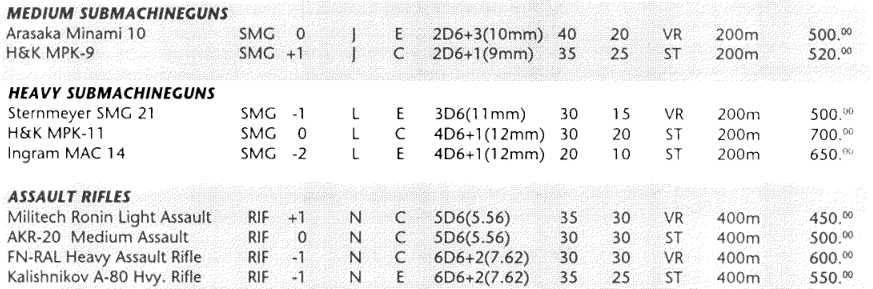
The first number after the damage dice is the ammo capacity for a weapon, and the second is its per turn rate of fire. Meaning, you could easily empty most of these in a single combat turn!
Single shot works mostly the same way in Cyberpunk2020: Reflex + Skill + 1d10, vs [Range value]
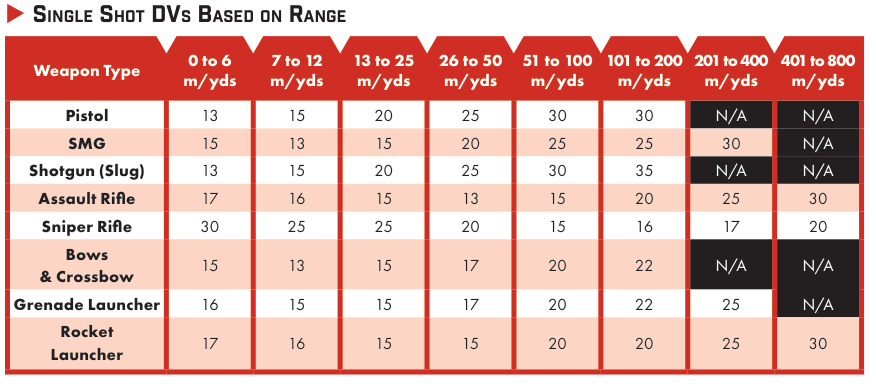
Though in Cyberpunk 2020, range values were determined by what kind of weapon you had, with bigger guns typically being more effective at longer ranges. This, was not necessarily the case in Cyberpunk RED.
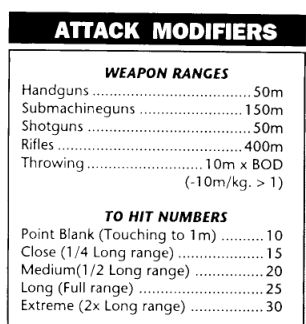
In Cyberpunk 2020, range values were determined by what kind of weapon you had, with bigger guns typically being more effective at longer ranges.
This, was not necessarily the case in Cyberpunk RED.
Side Note: Three Round Burst is an option that’s absent from CPRED, but with a little bit of thinking, wouldn’t be hard to re-implement if somebody really wanted to. It was simple though: you fired three bullets from a weapon, and got a +3 to hit. With the limitation that it was only available at Close and Medium range and if you had a weapon capable of burst fire.
Full Auto is our reason for writing this, however. So let’s go over some of the basics of that.
It allows for hitting multiple enemies, and at close range even grants a bonus per bullet used! However, this bonus actually becomes a penalty at Medium, Long, and Extreme ranges!
That said, for each point over the target number you make it by, that counts as one extra bullet hitting the target, limited of course by the amount of bullets shot. No makings 30 shots and filling somebody with 40 entry wounds!
Things get a little murky here, though, since it states that’s how many bullets get put into the target, but it doesn’t explicitly state if each bullet counts as it’s own hit or not. Though, given how Cyberpunk 2020 makes it clear that Friday Night Fire Fight is meant to be brutal, it’s not a stretch to assume that it does.
Going with that ruling would mean you can feasibly fill somebody with 20 rounds from a Arasaka Minami 10 for 20 hits, dealing a total of 40d6+60 Damage. Which, at that point, should you even roll for damage?
This also means that my friend’s modification to CPRED is in the spirit of what Cyberpunk 2020 uses: where there’s no kill quite like overkill!
GURPS 4e
GURPS 4th Edition is a game with a reputation for having an insane amount of granularity, and this is a reputation that is very well earned. The reasonable consideration for running any GURPS game, though, is to only worry about what’s important to your game. (e.g. If you’re playing a game about highschool drama, you probably won’t need many rules about auto-fire.)
First and foremost, the rules to GURPS 4e are spread across two books: Characters and Campaigns. Characters is about making a character, and Campaigns is pretty much all the other, more specific rules.
The only thing Characters book has regarding Rapid Fire, is that it can be added to an Innate Attack Advantage to make it fire more than once per round. For an explanation of what this means, you need to consult the Campaigns book. This is where we find the general rules for Ranged Attacks.
Ranged attacks follow the standard sort of procedure you’d expect: find your skill rating with your weapon, apply modifiers, and then roll to see if you succeed. In the case of GURPS, you’ll most often be trying to roll under your Dexterity rating.
If we look a little beyond this point, we see how GURPS handles all the possible consideration for ranged attacks, starting with an explanation of the various bonuses mentioned in the basic rules, such as Aiming, Size of the target, and moving targets.
It’s a few columns into this that we find Rapid Fire. It introduces a Recoil stat, as well as a chart for how many shots fired, compared to the bonus it gives.
The Recoil stat is used for determining how many extra shots you make, limited by the amount of shots you fired. For every amount beyond your recoil rating you succeed by, you land an additional hit.
And of course, every hit lets you roll that many more damage dice!
Army Men: Plastic Soldiers, d20 Action
As a bonus, I want to spend a little bit of time talking about different weapons in a D&D 5e based game called Army Men.
It’s an indie title where you play as plastic toy soldiers, and it places a lot of emphasis on the gear characters have, and what unusual tricks of the trade they may have learned beyond basic combat training.
One of the things that Army Men does, is it removes magic. Since D&D 5e’s weapon system (at least, as of the 2014 rules set) has mostly unremarkable weapons, Army Men makes weapons more spectacular by filling that void that magic being gutted removes.
Including, giving different weapons different kinds of special qualities, even when they’re in the same “class” of weapon. Many of which rely on different tags, and lots of minute details for weapon ranges, and other special uses.
And most importantly, tags to describe the qualities common among all weapons. There’s a hand full of these tags that apply to machine guns of all sizes.
Burst Fire – Grants Advantage on the attack roll, and uses three rounds
Full Auto – Creates a linear AoE up to the weapon’s range, using 10 rounds. Grants Advantage on first target, normal roll on second, disadvantage on all following targets.
Brace – Disadvantage when a bonus action isn’t first spent bracing against a solid object or setting up a bipod.
Bipod – It has a collapsible bipod that can be set up for +2 accuracy bonus, and also counts as bracing when being used.
Every gun has a wide variety of ranges, ammo capacities, and damage ratings, meaning there’s a lot of granularity in choosing what features you want out of your weapon.
For example, The Stormer and the Avalanche may be very similar, but the deciding factor on which you want would be whether you’re going to be using it close or long range. The Avalanche being better for short range because of the extra damage it does up close, and The Stormer being able to hit further, though with a tighter damage range.

Leave a Reply