When Dungeons and Dragons 4th Edition was on the way out, but 5th Edition was still in the works, there was a massive playtest conducted via the Internet to shape what the new D&D would be like. I took part in this, as many others did. For our efforts, we were rewarded with a PDF copy of The Temple of Elemental Evil, from AD&D 1st edition.
Also known as The Quintessential Dungeons and Dragons Campaign.
I finally made time to read through it. Skimming at first to figure out the broad ideas, then reading a few important looking sections in more detail later. I then decided I wanted to convert the campaign into HERO System 5th Edition, for reasons we won’t go too much into detail about here.
There’s a lot to be learned from this that can be applied… Honestly to any ttRPG.
A Recurring Problem
Tabletop RPG players from both mine, older, and younger generations acknowledge them: Murder Hobos; Player Characters that have no apparent home, and are only concerned with butchering monsters. (Or other living beings.) If these player characters can overpower it, it will die. And if they cannot overpower it, they will die trying.
Alternatives to Fighting To The Death
For whatever reason, the assumption is that once “Roll For Initiative!” has been called, irons are drawn, and nobody is leaving except in a body bag. However, the Temple of Elemental Evil has numerous excerpts like the following:

a particularly “enterprising” party may
decide is worth a fight to the death.
If an antagonistic NPC is powerful enough, they’ll surrender and try to bargain for their life: either by offering treasure they have on hand, or their service to the player characters. To hammer in how Evil character’s were expected to behave in earlier editions of Dungeons and Dragons, they’ll often just be biding their time to escape or otherwise turn the tables. This theme is apparent in many places through the text.
Making Villain Hierarchies Work For You
Antagonists throughout the Temple of Elemental Evil campaign book seem to fall into one of three categories based on how the text describes them and their behavior. I’ve named these three categories Troopers, Sergeants, and Majors.
Troopers – Rank and file foot soldiers with little to lose, little to gain, and little description.
Sergeants – Usually described as “[X] Leader,” or otherwise described as being in charge of a certain group of Trooper NPCs.
Majors – Characters that are often named, and have a paragraph describing their motivations and schemes. Furthermore, the text explicitly states they’ll try to bargain when things go badly for them.
We’ll start by looking at Majors. These characters can be described as “boss” characters. They’re powerful in many ways, though usually because of a command of both magic, and of henchmen. They also have a nice hoard of treasure, to boot. (Useful for keeping Sergeants and Troopers loyal.)
Mechanically, they’ll have the highest HP out of most enemies you’ll encounter. So unless an aggressor gets insanely lucky, they can take a few hits without being pulped. This of course means that they can survive long enough to see things are going wrong, and thus put their hands up and beg for their life. (Especially if their Sergeants and Troopers are dead or otherwise no longer able to assist.)
Sergeants are kind of in the middle, they stand out more than the Troopers, either by being their spokesperson, or being recognized by a Major as somebody capable. Thus, they have a reason not to give up. Successfully thwarting an the PCs could further advance their career as an evil henchman, or at least warrant some substantial reward. If anybody is going to fight to the death, it’ll most likely be Sergeants.
Troopers are the lowest, and are probably the most likely to run away if things go wrong. At least, if their Sergeant isn’t around. In fact, that’s actually A Thing™ in Advanced Dungeon and Dragons 2nd Edition.
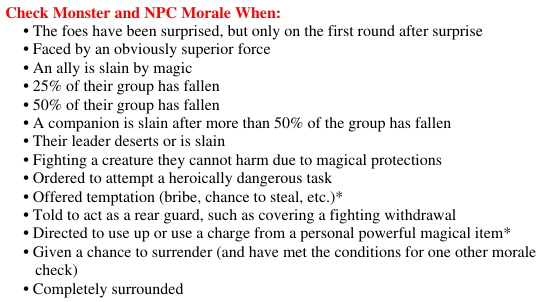
of the more detailed parts of AD&D 2e!
Morale was one of the things in early Dungeons and Dragons that balanced out some of the weaknesses of wizards early on. Having a magic user on your side made Trooper level characters less likely to freak out. Additionally, if one side had one and the other didn’t, the usage of magic could quickly turn the tides, simply by spooking them!
It’s Not Just A D&D Thing
To wrap this up, we’ve got two examples of how other games handle the idea of avoiding fights to the death:
The Dark Eye has writeups in their bestiary about how monsters will behave in combat, as well as the conditions under which they’ll flee from combat. Pictured below is from the write up of the Fire Djinni.
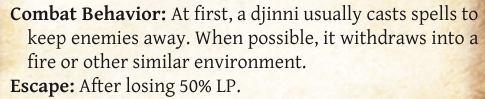
Exalted 3rd Edition has a robust “Social Combat” system, which relies on one of its core mechanics: Intimacies. Intimacies are quickly described as “the things your character cares about.” These can also be used to influence how a character may behave in combat, with a few charms even creating greater effect when used against the right kind of intimacy.
The specifics of how Intimacies work, however, is something that’s best described in a whole other article.
Leave a Reply